
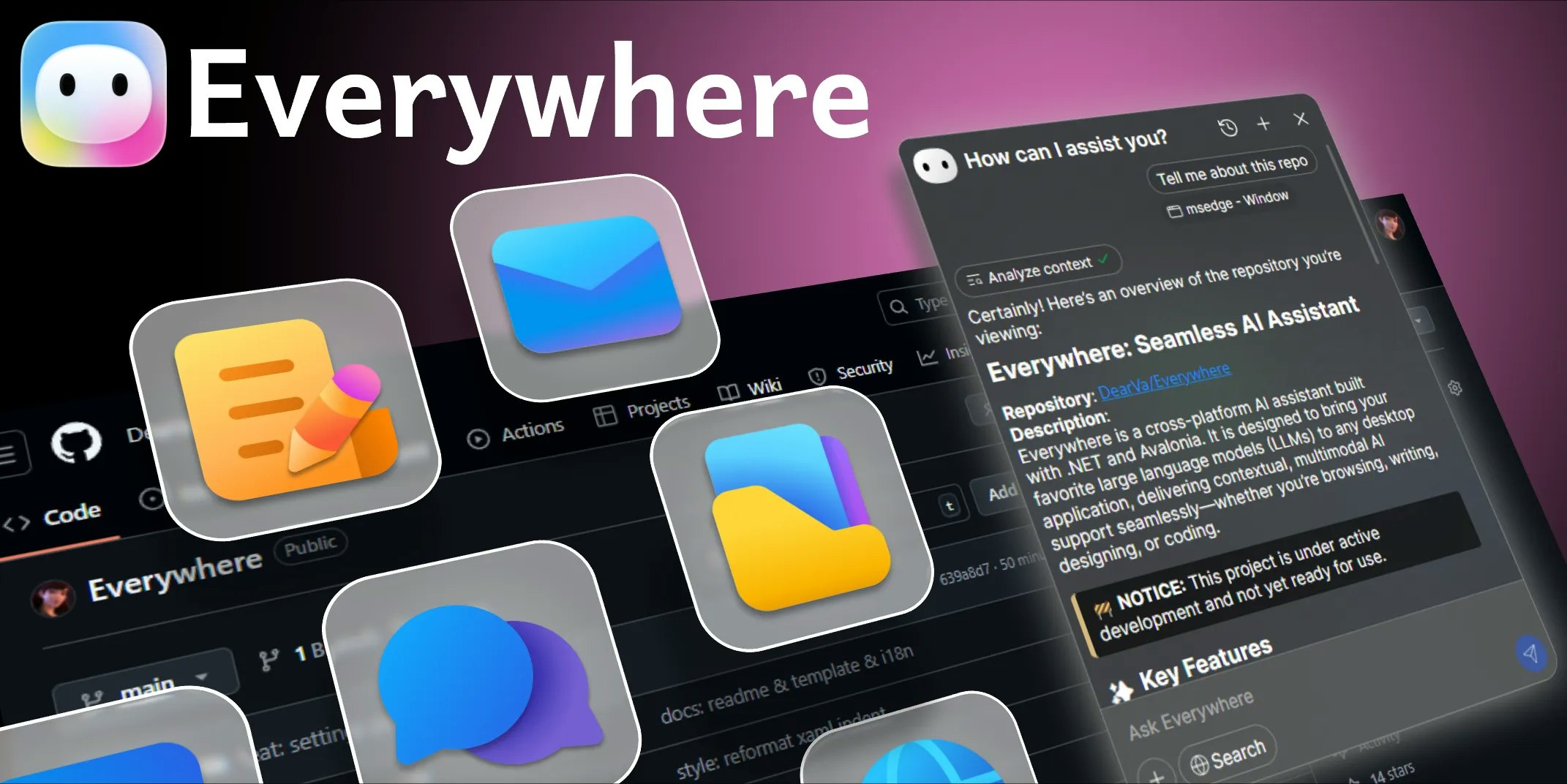
Everywhere: Your AI, Seamlessly Integrated into Your OS
Every moment, Every place. Your AI: Everywhere
Everywhere is an innovative AI assistant that aims to fundamentally change how users interact with artificial intelligence. Moving beyond the confines of browser tabs and individual applications, Everywhere positions AI as a native, omnipresent capability within your operating system. The core value proposition lies in its seamless integration and context-awareness, offering a significant leap in productivity by bringing AI assistance directly to your workflow, precisely when and where you need it.
This tool is designed for anyone who frequently uses a computer and wishes to streamline their digital tasks with intelligent assistance. From professionals drafting emails and summarizing documents to developers troubleshooting code and researchers gathering information, Everywhere caters to a broad audience seeking to enhance efficiency and reduce context-switching. It’s an ambitious play to make AI truly ubiquitous and an integral part of the computing experience.
Problem & Solution
The prevalent challenge with current AI tools like ChatGPT is their siloed nature. Users often have to manually copy content, switch applications, or even take screenshots to get AI assistance, disrupting their flow and reducing overall productivity. This friction creates a barrier to truly leveraging AI's potential in day-to-day computing.
Everywhere directly addresses this pain point by enabling real-time perception and understanding of any content on your screen. Instead of cumbersome manual inputs, a simple hotkey can invoke the AI, allowing it to interpret the on-screen information and provide immediate, relevant assistance. This approach eliminates the need for constant app switching and manual data transfer, making AI a fluid extension of your operating system. This fills a significant market gap for truly integrated, context-aware AI that operates at the OS level, a direction that major operating systems are also beginning to explore.
Key Features & Highlights
Everywhere boasts a compelling set of features designed for a fluid user experience and robust AI capabilities:
- Context-Aware Invocation: The assistant understands the user's current context, providing more relevant and accurate responses. For instance, if you're looking at a foreign language document, Everywhere can instantly translate it.
- Multi-model Provider Support: Everywhere isn't tied to a single AI model. It integrates with various popular LLMs and providers, including OpenAI, Anthropic (Claude), Google (Gemini), DeepSeek, and even local models via Ollama. This flexibility allows users to choose the best AI for their specific task.
- Inline Overlay User Interface: The AI assistant operates as an inline overlay, meaning it doesn't disrupt your primary workflow. You can interact with it directly over your current application, preserving focus and efficiency.
- Actionable Responses: Beyond just providing information, Everywhere aims to offer actionable responses, potentially integrating with other applications to help you complete tasks directly.
- Cross-Platform Integration: A significant advantage is its seamless functionality across Windows, macOS, and Linux, ensuring a consistent experience regardless of your operating system.
- Desktop & UI Automation: Everywhere can interact with OS interfaces to automate repetitive workflows and context-driven assistant behaviors, further boosting productivity.
- Privacy Focus: The product emphasizes privacy and extensibility, with support for local model usage for privacy-sensitive or offline scenarios.
These features collectively create a powerful and unobtrusive AI companion that truly lives up to its "Everywhere" moniker.
Potential Drawbacks & Areas for Improvement
While Everywhere presents a promising vision for integrated AI, there are a few considerations and potential areas for improvement:
- Security Concerns with Screen Access: An AI with real-time screen perception, while incredibly powerful, also raises significant security and privacy concerns. Users will need robust assurances that their on-screen data is handled securely and that they have granular control over what information the AI can access and process.
- Resource Intensiveness: Running AI models that constantly perceive and process screen content could be resource-intensive, potentially impacting system performance on older or less powerful machines. Optimization for efficiency will be crucial.
- Learning Curve for Advanced Features: While basic invocation might be simple, leveraging the full potential of multi-model support, tool integration, and UI automation might require a steeper learning curve for some users. Clear documentation and intuitive onboarding will be key.
- Accuracy and Contextual Nuance: The effectiveness of any screen-aware AI hinges on its ability to accurately understand context and nuance. There might be instances where the AI misinterprets on-screen information, leading to less accurate or irrelevant responses. Continuous improvement in this area will be vital.
Bottom Line & Recommendation
Everywhere represents a significant step towards a more deeply integrated and truly helpful AI experience. By liberating AI from application silos and embedding it directly within the operating system, it promises substantial productivity gains for anyone who spends a considerable amount of time working on a computer. The ability to understand on-screen content in real-time and offer context-aware, multi-modal assistance is a game-changer.
If you're a power user, developer, writer, researcher, or simply someone looking to drastically reduce friction in your digital workflow, Everywhere is definitely worth exploring. While acknowledging the importance of addressing security and performance, its innovative approach to AI integration positions it as a frontrunner in the evolving landscape of intelligent computing. It has the potential to transform how we interact with our devices, making AI a silent, ever-present co-pilot for every task.